Interlock Guide · Summer 2026
How Long Does an Interlock Driveway Take? A Day-by-Day Look at Install Week

A standard Ontario interlock driveway of 800 to 1,200 square feet takes 5 to 8 working days, and you park on it the day we finish. That last part is the one homeowners never see coming, so lead with it: pavers are drivable immediately. Edge restraints go in, the joints get filled, the plate compactor makes its final pass, we sweep up, and your car goes back on the driveway that evening. A poured concrete driveway needs 7 to 10 days of curing before a car touches it, and 28 days before it reaches full strength.
So the honest comparison is not "3 days of work versus 6." It is total days without a driveway. Concrete: 2 to 3 days of work plus 7 to 10 days of curing, call it 10 to 13 days before you park. Interlock: 5 to 8 days of work plus zero curing. The gap most people assume is there mostly is not.
It is mid-July, which is when our fall calendar fills up. If you are weighing a September or early-October slot and trying to work out whether the driveway is back before Thanksgiving, this is the page for you. Here is what install week actually looks like.
What Happens Each Day of an Interlock Driveway Install?
| Stage | Typical time | What we are doing | What it means for you |
|---|---|---|---|
| Site prep & layout | 1 to 2 days | Utility locates confirmed, string lines and grades set, garage door and lawn protected, bin and materials staged | Cars out. The bin lands, usually curbside. Keep the front walk clear. |
| Excavation & base | 1 day (2 if the subgrade is bad) | Strip old asphalt or concrete, dig 12 to 14 in., lay geotextile, build 8 in. of granular in 3 to 4 in. lifts, compact every lift | Loudest day of the week. Excavator and plate compactor, roughly 7:30 to 5. The garage is unreachable. |
| Bedding sand | Half day | Screed 1 in. of clean bedding sand over the compacted base, dead flat, holding a 2% fall away from the garage | Quiet day. Nobody walks on a screeded bed, including you. |
| Paver laying | 1 to 3 days | Set the pattern off a straight edge, run the field, then cut the perimeter and any curves on a wet saw | The visible day. This is when it suddenly looks like a driveway. |
| Edge restraints & joint sand | 1 day | Spike edge restraints on every unsupported edge, sweep in joint sand, fill every joint full | Wet saw and hammer drill noise. Water stays off the pavers from here if we are using polymeric. |
| Final compaction | Half day | Plate compact over a protective pad to lock the pavers into the bedding, top up the joints, final sweep and walkthrough | You park on it that evening. |
Read that table twice and you notice something. Only 1 to 3 of those days are pavers. Everything before them is base. That ratio is not padding, and it is the whole argument of this page.
How Long Does It Take by Driveway Size?
- Single-car, 400 to 600 sq ft: 3 to 4 working days. The smallest thing we would call a driveway, common on the older lower-city and Westdale streets in Hamilton.
- Standard two-car, 800 to 1,200 sq ft: 5 to 8 working days. This is the majority of what we build in Burlington, Oakville and Ancaster.
- Wide or double-deep, 1,500 to 2,000 sq ft: 8 to 12 working days, more if there is a turnaround or a banded border with heavy cutting.
- Driveway plus front walkway and steps: add 2 to 4 days. Steps are slow, fiddly work and they do not get rushed.
Those are working days, not calendar days. A 6-day install starting Monday finishes Monday of the following week if you lose a day to weather, which in an Ontario shoulder season you often do. So we quote a window, not a date. Anyone handing you a guaranteed finish date in October has not been doing this long.
Where Do I Park, and When Does the Truck Come?
Move both cars the evening before Day 1 and leave them off until we hand the driveway back. There is no window mid-week where you can sneak a car on. Once the excavation is open it is a pit; once the base is compacted, a car parked on bare base leaves ruts we then have to re-screed. The practical notes:
- Street parking. Hamilton and most Halton municipalities cap on-street parking at 3 hours without a permit, and overnight rules vary street to street. Sort out a temporary parking permit before install week. It is a few dollars a day online and it saves you a ticket on Day 3. A neighbour's driveway is easier if you have the relationship.
- The bin. A disposal bin lands on Day 1 and sits curbside or on the boulevard most of the week. Some streets need a road occupancy permit for that. We handle it where it applies; ask at the quote.
- Materials. Granular arrives by dump truck on Day 1 or 2. Pavers come in on skids by boom truck, usually the day before we start laying. Both need a clear approach and roughly 15 feet of overhead clearance, so we will ask about low branches and hydro lines.
- Hours and noise. We run 7 to 7, Monday to Saturday. The excavator and the compactor live on the base day, and that is as loud as the week gets. Warn the neighbour who works nights.
- Garage access. On excavation day the garage is unreachable. Pull out whatever you need for the week first: bikes, the mower, the recycling bins.
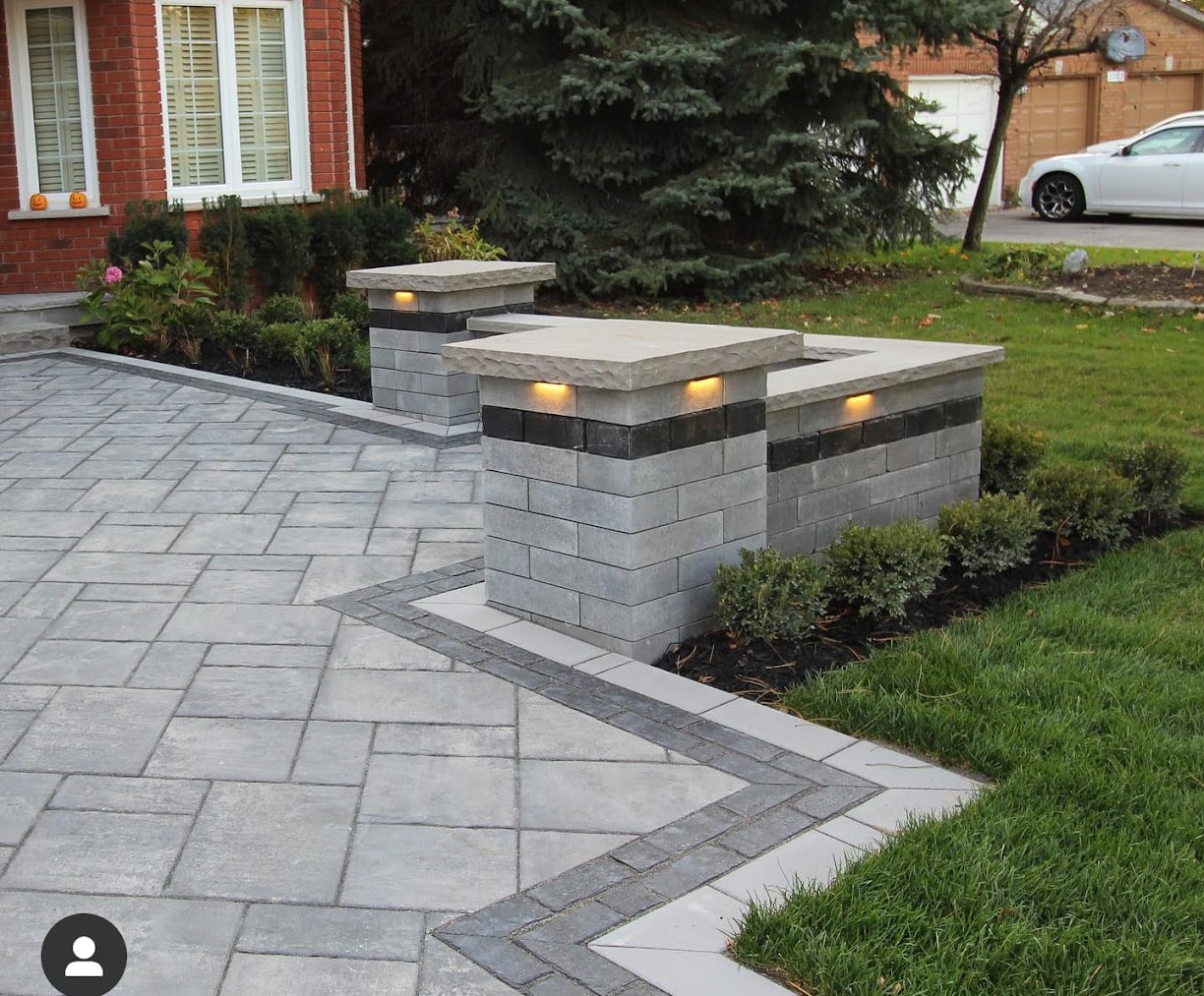
Why Is One Quote 3 Days and Another 6?
Because the 3-day quote is skipping base days. That is not a cynical read. It is arithmetic.
We build driveways on 8 inches of compacted granular, placed in 3 to 4 inch lifts, with a compaction pass on every lift. You cannot dump 8 inches and hit it once. A plate compactor only meaningfully densifies the top 3 or 4 inches. Below that the material stays loose, and it consolidates later under the weight of your car, one winter at a time. That is why sunken driveways show up in year three rather than year one. The full method is in how we install interlock patios and driveways in Ontario if you want the technical version.
This matters more here than almost anywhere. Frost depth in the Hamilton and Halton area runs about 4 feet, and most of our region sits on Halton Till, a dense clay that holds water and heaves when it freezes. A thin base over wet clay is a driveway that moves every spring. A properly built 8-inch base gives the water somewhere to go and gives the freeze-thaw cycle nothing to lift.
So when two quotes come back with different timelines, do not read the shorter one as efficiency. Ask three questions: How many inches of base? In how many lifts? How many days is that? A contractor genuinely building 8 inches in lifts cannot honestly say three days, and one who says three days is telling you what his base looks like whether he means to or not. The timeline is the cheapest diagnostic you have. For where the money goes, we break it down in interlock driveway cost in Hamilton, Burlington and Oakville.
What Actually Stretches the Timeline?
Five things, in rough order of how often they bite us.
- Rain during excavation or base work. The big one. Saturated clay cannot be compacted, full stop. Run a compactor over a wet subgrade and you pump clay up into the granular, contaminating the base and ruining the thing you are paying for. We tarp the excavation and wait. Adds 1 to 3 calendar days.
- Poor subgrade. We dig 12 inches and find soft, wet, organic fill a builder left behind, or an old buried patio. It has to come out and be replaced with granular, which means more excavation and more base. Adds 1 to 2 days, and it is the most common reason a number moves mid-job. We flag it the hour we find it, with photos, before touching anything.
- Utility conflicts. A shallow gas line, an old irrigation main, a hydro service to a detached garage nobody mentioned. Ontario One Call locates happen before we dig, but locates are not perfect and private lines past the meter are not covered at all. Adds a day or two, occasionally a redesign.
- Drainage found on site. If the existing driveway has drained toward the garage for 15 years, we are not rebuilding it to do that again. Re-establishing a proper 2% fall away from the house can add a day. Worth every hour of it.
- Heavy cutting. Circles, curves, banding, a herringbone field meeting a curved border. Every one of those is a wet saw cut and it is slow. A curved layout can add 1 to 2 days over a rectangle.
What Is Your Rain Policy?
Two rules, and neither one bends.
We do not compact wet clay. If the subgrade is saturated, the excavation gets tarped and we come back. This is the rule that costs us the most money, and it is not negotiable, because everything above the base is only as good as the day we compacted it.
We do not sweep polymeric sand with rain inside the cure window. Polymeric jointing sand needs a dry set period after activation, generally around 24 hours depending on the product and the temperature. Rain in that window washes binder out of the joints and leaves a haze on the paver faces that is a genuine pain to remove. If the forecast is bad, we hold the joint sand for the next dry day. Details are on polymeric sand cure time and rain risk in Ontario.
What rain does not stop: laying pavers. Light rain during the field is fine and we keep going. Nothing about a paver minds being wet, which is another quiet advantage over concrete, where an unexpected downpour on a fresh pour can compromise the surface permanently. The worst rain does to your interlock install is delay it. The worst rain does to a concrete pour is ruin it.
Booking a Fall Slot: What to Know in July
Our September and October calendar is where deposits are landing right now, and fall is a genuinely good time to build interlock. Cooler working temperatures, drier ground than spring, and no curing clock. The practical cutoffs:
- Book 6 to 10 weeks ahead. A July deposit typically lands a September or early-October start. On a normal 5-to-8-day install that finishes comfortably before Thanksgiving weekend, with room for two rain days.
- Late October and November still work for pavers, with one caveat: polymeric sand generally wants surface temperatures around 0 C and rising, dry, to activate properly. Late in the season we may set the joints with regular sand and come back in spring to polymeric it. We tell you that up front if it is a risk on your job.
- Concrete has a harder wall. Pouring in cold weather means blankets, admixtures and a longer cure. If you are choosing between the two for a late-season job, that is a real factor, and we compare them honestly in interlock vs concrete vs asphalt driveway cost.
- Permits, if any. Most straight driveway replacements do not need one, but widening a driveway or changing the curb cut does, and that is a municipal process with its own clock. See landscaping permits in Hamilton, Burlington and Oakville.
A Week Is a Week. A Driveway Is Thirty Years.
Six days is a real inconvenience. Parking on the street, walking around a bin, listening to a compactor on a Tuesday morning. We are not going to pretend otherwise. But the trade is six days now against a driveway that should hold its line for 25 to 40 years in Ontario, if the base underneath it was built properly on the days you could not see.
The contractor offering to do it in three is not saving you three days. He is spending your base days somewhere else, and you get them back with interest in year four, when the apron starts to dish and you are reading our page on why hardscaping sinks instead of parking on your driveway. If the terms in this article are unfamiliar, our hardscaping glossary covers lifts, screeding, edge restraints and the rest, and if you want to check credentials before anyone digs, start with what ICPI and authorized-installer status actually mean.
Frequently Asked Questions
Related Reading
- How we install interlock patios and driveways in Ontario
- Interlock driveway cost in Hamilton, Burlington & Oakville
- Polymeric sand cure time & rain risk
- Interlock vs concrete vs asphalt driveway cost
- How long does interlock last in Ontario?
- How long does a concrete driveway last?
- Interlock patios & driveways service
- Concrete driveways service
- Patio & driveway sinking: causes and fixes
- Hardscaping terms glossary
Looking at a fall driveway slot? We build interlock driveways across Hamilton, Burlington, Oakville, Milton, Mississauga, Ancaster, Dundas, Stoney Creek and Waterdown, and you get a day-by-day schedule with the quote. Get a free quote