Local Service Page
Concrete Driveway Contractor in Hamilton
Concrete driveways take a beating in Hamilton. Salt, freeze-thaw, and the older clay subgrades on most properties all work against a slab over the long run. We pour concrete driveways across Hamilton with the mix design, base depth, and drainage detail that lets a slab actually last 25 to 35 years instead of cracking out at 12.
Quick answer: Seven Stones Landscape installs concrete driveways across Hamilton — Westdale, Hamilton Mountain, Stoney Creek and nearby — for $14,000 to $24,000 installed on a standard 2-car driveway (2026), poured on a compacted, drainage-first granular base. ICPI-certified, $5M insured, with 4,000 PSI air-entrained mix.
Why Hamilton Homeowners Hire Us
If you are comparing concrete driveway contractors in Hamilton, the most important questions are not about colour or finish. They are about mix strength, air entrainment, base prep, and how the driveway sheds water. A 4,000 PSI air-entrained mix on a properly prepared 6 to 8 inch granular base behaves very differently from a 2,500 PSI pour on uncompacted clay.
Hamilton driveways also deal with road salt heavier than most parts of the GTHA. Cars carry salt up the driveway every winter. That is why we use air-entrained concrete (5 to 7 percent entrained air), apply a penetrating siloxane sealer at year one, and recommend a sealer reapplication every 3 to 5 years. Without those steps, salt scaling shows up by the third winter on a lot of Hamilton lots.
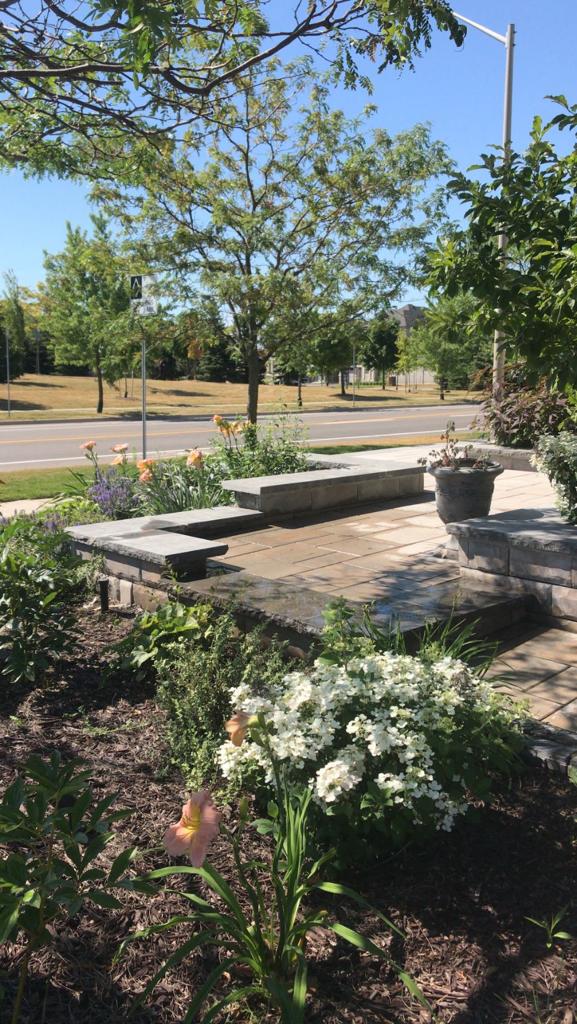
Many Hamilton concrete driveway projects pair with new concrete steps, front-yard landscaping, or retaining wall work on slope lots. If the project is broader than just the driveway, we can scope it that way from the first quote.


Local Considerations & Credentials
- Credentials: ICPI certified for hardscape, Landscape Ontario member, $5M liability, full WSIB. We pour to OPSS-spec mixes from Lafarge, Dufferin, or CRH, and use only air-entrained concrete on all Hamilton driveway pours.
- Site Conditions: Most Hamilton lots sit on Halton Till clay. We compact the subgrade, then build 6 to 8 inches of compacted Granular A or 3/4-clear limestone before the slab. Mountain edge and Stoney Creek slope lots may need a deeper base or a poured retaining curb. Westdale and Cootes Paradise have sandier soil that drains better.
- Performance Detail: 4,000 PSI air-entrained concrete (5 to 7 percent air), poly-vapour barrier on clay, fibre or wire reinforcement, 4 to 6 inch slab thickness depending on use, control joints sawn or tooled at 8 to 12 foot spacing, and a year-one penetrating sealer. Cure under wet burlap or cure-and-seal compound for 7 days minimum.
- Local Tip: Hamilton requires a Right-of-Way permit any time the curb cut, boulevard, or apron is altered. The concrete inside your property line does not need a building permit, but the apron portion at the street does. We pull the ROW permit through Hamilton Public Works as part of the project.
Concrete Driveway Cost in Hamilton (2026)
Installed pricing for a standard 2-car Hamilton concrete driveway (400 to 600 sq ft), with the page's own finish upgrades applied on top of the base broom-finish range.
| Option | Typical range (installed) | What's included |
|---|---|---|
| Standard broom-finish concrete | $14,000–$24,000 | 4,000 PSI air-entrained mix, 6-inch granular base, fibre reinforcement, sawn control joints |
| Exposed aggregate (adds 20–35%) | $16,800–$32,400 | Standard build with exposed-aggregate decorative finish |
| Stamped or coloured (adds 30–50%) | $18,200–$36,000 | Standard build with stamped pattern or integral colour |
Why Hamilton Homeowners Choose Seven Stones for Concrete Driveways
Picking a concrete driveway contractor in Hamilton usually comes down to who actually understands the ground under the slab. Most of our work in Westdale, Durand, and across Hamilton Mountain sits on Halton Till clay that heaves with frost, so we compact the subgrade and build a drainage-first base before a single yard of concrete is poured. We have been doing this work since 2013 as an ICPI-certified, Unilock and Techo-Bloc authorized installer, and we carry $5M liability so you are protected from the first day of excavation to the final cure.
As a local concrete driveway company, we put everything in a fixed written quote, back the finished slab with a 5-year workmanship warranty, and handle the Hamilton Right-of-Way permit ourselves when the apron is involved. Whether you are in Stoney Creek, Kirkendall, or up on the escarpment, the next step is a free on-site Hamilton consultation. Call (289) 700-0312 or request a quote online at /contact/.
Hamilton Concrete Driveways FAQ
Concrete Driveways in Nearby Cities
Same crews, same base specs, same 5-year workmanship warranty across the Golden Horseshoe.