Local Service Page
Concrete Walkways Hamilton: Poured Path & Walkway Installation
If you're looking for a concrete walkway contractor in Hamilton to pour a clean path from the driveway or city sidewalk to your front porch, this is the page. We form and pour broom-finish concrete walkways on a properly compacted base, saw-cut the control joints at the right spacing, and use a salt-rated 32 MPa air-entrained mix so the surface doesn't scale after one winter. We build walkways across Westdale, Durand, Crown Point, Stoney Creek, Ancaster, Dundas and the Hamilton Mountain.
Quick answer: Seven Stones Landscape installs poured concrete walkways across Hamilton — Westdale, Durand, Crown Point and nearby — for $14-$30 per square foot installed (2026), built on a compacted 3/4-clear granular base with saw-cut control joints and a salt-rated 32 MPa mix. ICPI-certified, $5M insured, 5-year workmanship warranty.
What This Page Covers
- Poured concrete walkways from the driveway or city sidewalk to the front porch in Hamilton
- Side-yard and rear-entry paths, plus walkway tie-ins to existing driveways and landings
- Slab thickness, base depth, control-joint layout, and salt sealing that determine how long the path lasts
Service Detail
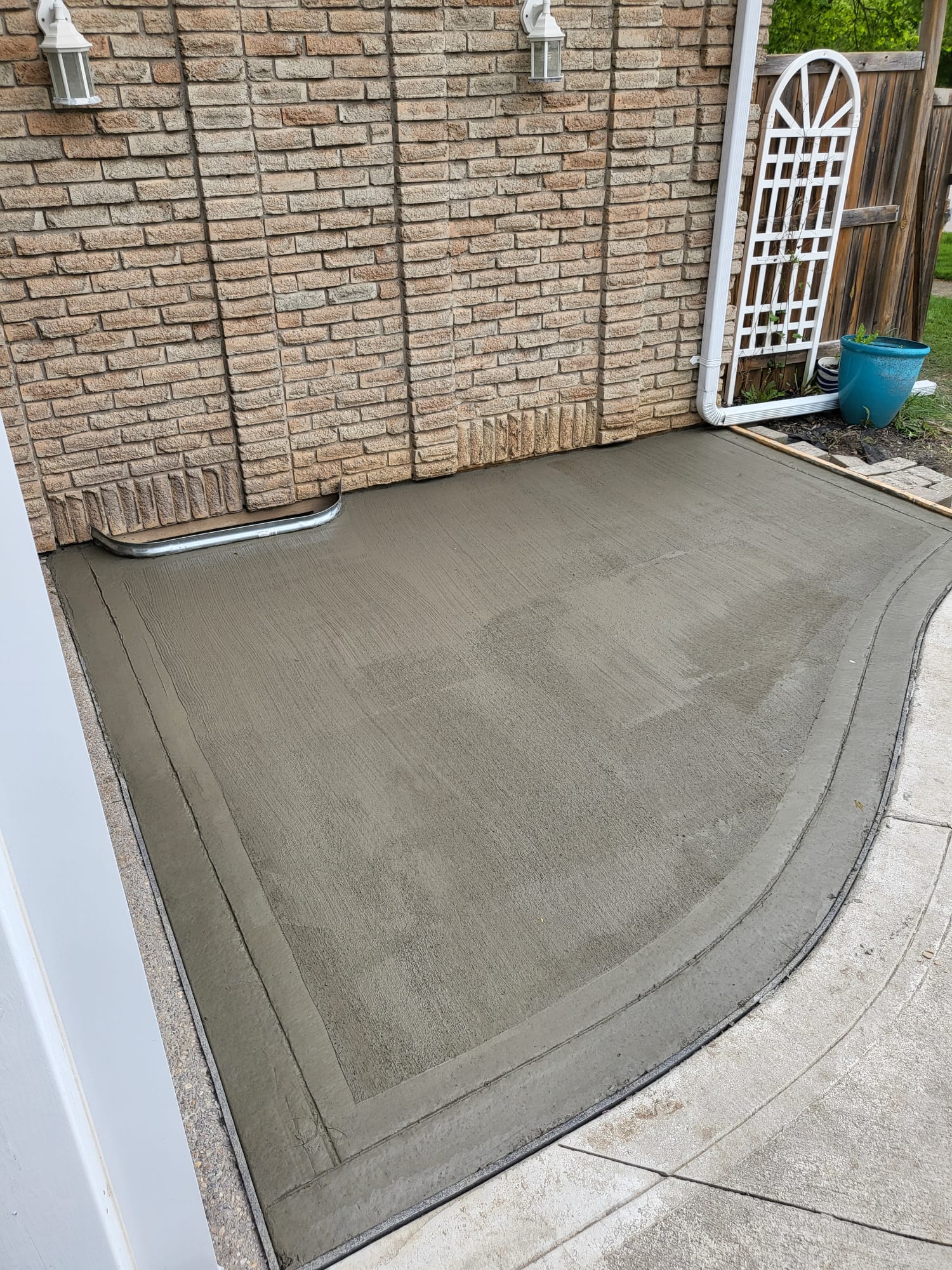
A concrete walkway is only as good as what's under it. The two failures we get called to replace are slabs poured straight on undisturbed clay with no compacted base, and slabs with no proper control joints that crack on their own random line within a season or two. We start every Hamilton walkway with excavation, a 6-inch compacted 3/4-clear granular base, and a slab pitched to shed water away from the foundation.
Width and layout matter as much as the mix. A primary front path needs 42 to 48 inches so two people pass and a shovel clears it; a side path to a gate can sit at 30 to 36 inches. We saw-cut control joints every 8 to 10 feet, reinforce with fibre or wire mesh (10M rebar on weaker clay subgrades), and finish with a broom texture for grip on icy Hamilton mornings.
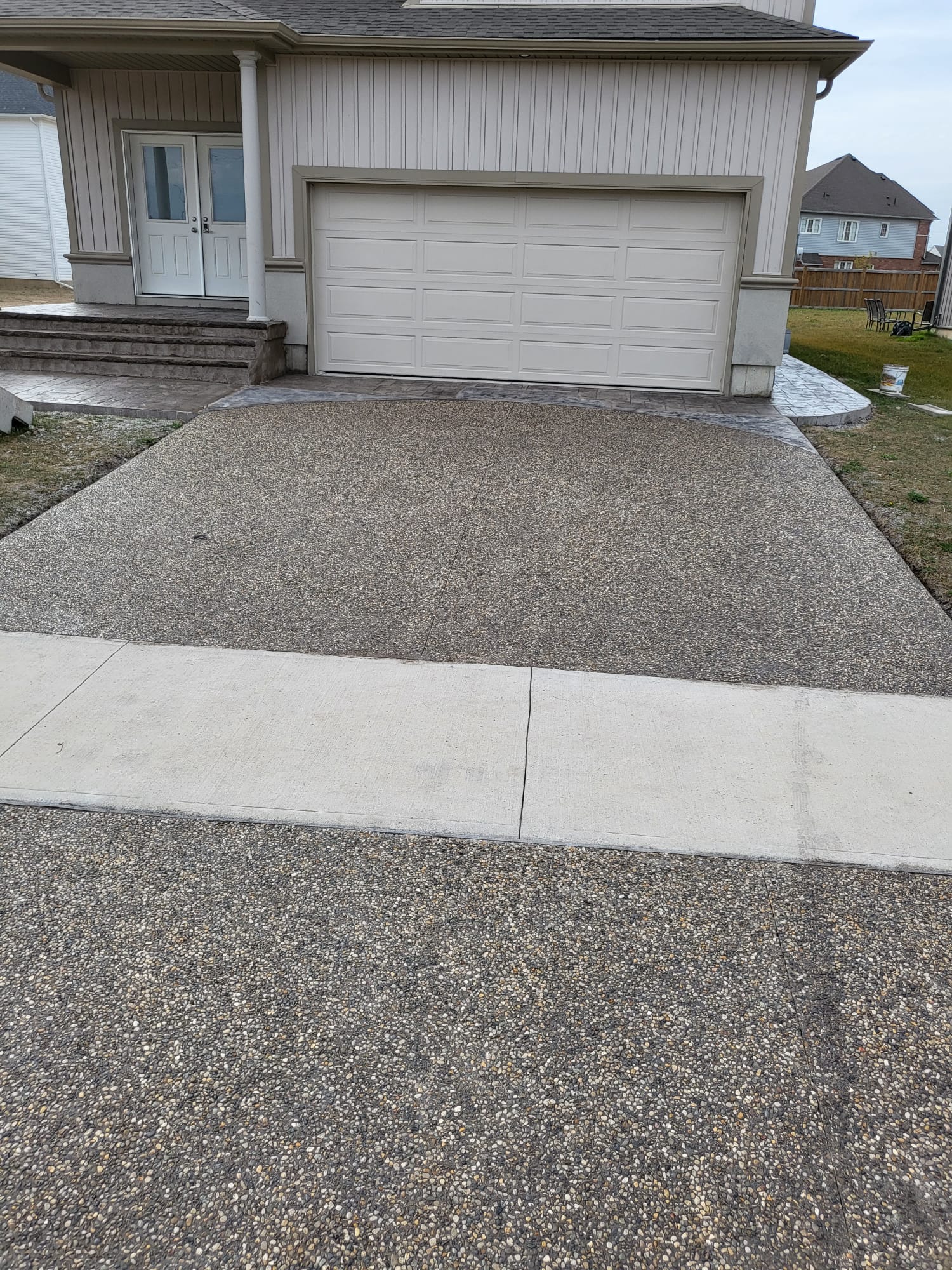
Walkways rarely live alone. We routinely tie a new path into an adjacent concrete driveway or front concrete steps, and can fold the work into broader front yard landscaping so the whole approach reads as one project.


Local Expertise & Credentials
- Credentials: ICPI certified, Landscape Ontario member, authorized Unilock & Techo-Bloc installer, $5M liability, full WSIB. Est. 2013. 5-year workmanship warranty.
- Project Fit: Driveway-to-porch front walkways, side-yard and rear-entry paths, and sidewalk tie-ins across Westdale, Kirkendall, Ainslie Wood, Durand, Corktown, Crown Point, Stipley, Stoney Creek, Ancaster, Dundas, Waterdown, and the Mountain around Rymal, Upper James & Meadowlands.
- Local Review: "Our old path was cracked and heaving. The new poured walkway is dead level, drains away from the house, and came through the first salty winter with no scaling." - Homeowner, Hamilton.
- Riaad's Pro Tip: On Halton Till clay, don't skip the air entrainment. A 32 MPa mix with 5 to 7 percent entrained air is what stops the surface from flaking when the city plows salt past your walk all winter. Pair it with a year-one penetrating sealer and the path still looks new after a decade.
Concrete Walkway Cost in Hamilton (2026)
Installed pricing for a Hamilton front walkway by build and finish — all on the same drainage-first base, so the finish is a look-and-budget choice.
| Option | Typical range (installed) | What's included |
|---|---|---|
| Broom-finish, 4-inch slab | $14-$22 per square foot | 4-inch slab on compacted 3/4-clear granular base, saw-cut control joints, 32 MPa air-entrained mix |
| Reinforced 5-inch slab on clay | $20-$30 per square foot | 5-inch slab with 10M rebar or welded wire mesh for Halton Till clay subgrades |
| Exposed aggregate finish | Adds 15-25% to base price | Washed pebble surface over the same structural build; warmth and texture |
| Stamped concrete finish | Adds 25-40% to base price | Flagstone or brick pattern over the same structural build |
Why Hamilton Homeowners Choose Seven Stones for Concrete Walkways
Homeowners in Westdale, Durand and Crown Point call us because a concrete walkway only survives if it's built for the ground beneath it. On the Halton Till clay that sits under so much of the lower city and the Mountain, a path poured without a proper compacted base heaves the moment the first freeze-thaw cycle hits. As an ICPI-certified concrete walkway contractor in Hamilton established in 2013, we excavate to a real granular base, saw-cut the control joints at the right spacing, and pour a salt-rated 32 MPa air-entrained mix that shrugs off plow-thrown road salt.
Working with a concrete walkway company that is an authorized Unilock and Techo-Bloc installer, carries $5M liability, and backs every pour with a 5-year workmanship warranty means there are no surprises — you get a fixed written quote before we lift a shovel. Book a free on-site Hamilton consultation, call (289) 700-0312, or request a quote online through our contact page.
Hamilton Concrete Walkways FAQ
Walkway Finishes & Build Specs
Broom finish is the standard for a Hamilton front walkway — it gives reliable winter grip and reads clean against brick or siding. From there, exposed aggregate (a washed pebble surface) adds about 15 to 25 percent and brings warmth and texture, while stamped concrete that mimics flagstone or brick adds roughly 25 to 40 percent. All three sit on the same structural build, so the finish is a look-and-budget choice rather than a durability trade-off.
Underneath every finish is the part that decides whether the path lasts: a compacted 3/4-clear granular base, a 4- or 5-inch slab reinforced with fibre, wire mesh, or 10M rebar on clay, saw-cut control joints at 8 to 10-foot spacing, positive slope away from the foundation, and a penetrating salt sealer applied in year one. We can quote a walkway on its own or fold it into a matching concrete driveway for a single, consistent front approach.
Detailed Local Guidance for Concrete Walkways in Hamilton
When you compare concrete walkway quotes in Hamilton, look past the price-per-foot and ask what's specified below the surface. A cheap number often skips base depth, compaction, control-joint cutting, or air entrainment — the exact details that decide whether the path survives salt and freeze-thaw. A real walkway quote should name the slab thickness, the base, the joint spacing, the mix strength, and how the slope sheds water.
It also helps to ask how the new path meets everything around it: the city sidewalk, the driveway edge, the porch step, and the lawn grade. The best results treat the front approach as one connected surface rather than an isolated ribbon of concrete. That matters most on older lower-city lots and Mountain properties where existing grading near the foundation is uneven.
Planning, Pricing, and Long-Term Value
A good walkway outcome starts with honest scoping. We measure the run, set the right width for how the path is used, check how the grade falls toward or away from the house, and confirm where the path ties into the sidewalk, driveway, and porch. From there we recommend a straightforward replacement, a re-route, or a wider rebuild depending on what the site actually needs.
If you'd rather handle related work in one plan, we can coordinate driveway work front yard landscaping grading corrections and the concrete walkway build so the whole front of the home reads as one finished approach and holds up through Ontario winters.
Choosing the Right Walkway Scope
A walkway should be judged on both how it's built and how it looks against the house. Some Hamilton homes just need the cracked, heaving path replaced; others benefit from widening the run, correcting the slope, or matching the new pour to an adjacent driveway for stronger curb appeal. That's why we review the surrounding grades and transitions rather than quoting a bare strip of slab in isolation.